

How to use federal, state, and capital gains brackets wisely
Untangling the Tax Bracket Jungle
There is no shortage of jokes about taxes…and most of them land because they are true. The US tax code can feel like it was designed by a committee of sleep-deprived accountants, lawyers, and puzzle enthusiasts. But here is the thing: beneath the complexity lies opportunity.
If you understand how different types of tax brackets work and how they interact, you can make smart, strategic moves that keep more of your money compounding over time. Whether you are preparing for retirement or already there, learning to “fill your tax brackets” can mean the difference between paying what you owe and overpaying year after year.
Let’s unpack the three main types of brackets you will face: federal income, state income, and capital gains, and see how they fit together in a practical strategy.
1. Federal Income Tax Brackets: The Core of Your Tax Landscape
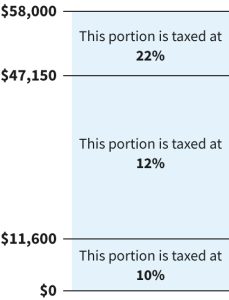
The federal income tax system is progressive, meaning your income is taxed in layers, not all at once. For example, for income in 2025, a married couple filing jointly will pay:
- 10 percent on the first slice of taxable income,
- 12 percent on the next layer,
- 22 percent on the next, and then 24 percent, 32 percent, 35 percent
- …all the way up to 37 percent.
This means that even if you land in, for example, the 22 percent bracket, only the portion of income that falls into that bracket is taxed at 22 percent; the rest is still taxed at 10 and 12 percent.
Why this matters:
Retirees and near-retirees often have multiple sources of income – pensions, Social Security, portfolio withdrawals, maybe even part-time consulting or rental income. Compared to wages for most pre-retirement work, you tend to have a lot more control over when these types of income appear in your bank account, and therefore your tax return. Coordinating when and how these income streams show up can help you “fill up” lower brackets without tipping into higher ones.
For instance, if your taxable income falls at the lower end of the 22 percent bracket, you might choose to do a partial Roth conversion, intentionally recognizing just enough income to “fill” that bracket. The idea is that you will pay a reasonable tax rate now to avoid higher rates later, when Required Minimum Distributions (RMDs) kick in and you lose some control over your income level.
Think of your tax brackets like the levels in a glass. Each year, the IRS gives you a new glass to fill. You cannot pour last year’s water into this year’s glass — but you can decide what kind of income fills it, and how full you fill it. Strategic planning helps ensure you are pouring in the right mix.
2. State Income Tax Brackets: The Often-Overlooked Layer
Depending on where you live, your state income tax system may add another layer of complexity.
Flat-tax states (like North Carolina) charge one rate on all income – simple, but not always painless.
Progressive-tax states (like California or New York) have their own multi-tiered bracket systems.
A handful of states do not tax income at all, which sounds great until you remember they often make up for it elsewhere: higher property taxes, sales taxes, or fees.
For retirees who plan to move, state tax brackets deserve real attention. A relocation might change not only your climate but also your effective tax rate. And if you are considering a move in retirement, timing can matter: capital gains realized before changing residency might be taxed differently than those realized after.
Working with an advisor who can model the “before and after” can help you make smarter timing decisions – not just about where to live, but when to sell assets or when to convert pre-tax investments to taxable or tax-free investments.
3. Capital Gains Tax Brackets: The Quiet Companion to Income Taxes
If two types of taxes does not seem like enough already, then there are capital gains tax brackets. This is a parallel system that applies when you sell investments or assets you have owned for more than a year. The long-term capital gains brackets (0 percent, 15 percent, and 20 percent) are famously lower than ordinary income rates, but they come with their own thresholds.
Here is where it gets interesting: your capital gains rate depends on your overall taxable income. For example, a couple with moderate taxable income in 2024 (less than or equal to $94,050) and well-managed withdrawals might qualify for the 0 percent long-term capital gains rate, effectively paying no federal tax on certain gains.
This creates powerful planning opportunities:
- Selling appreciated investments strategically to “fill” the 0 percent (or 15 percent) bracket
- Harvesting gains in low-income years (such as early retirement before Social Security begins)
- Coordinating Roth conversions and capital gains so one does not push the other into a higher bracket nor trigger “net investment income tax”
In other words, your income bracket decisions and your capital gains bracket opportunities are joined at the hip. Ignore one, and you might unintentionally raise the other.
Putting It All Together: The Annual “Bracket Check-Up”
A good financial plan is not just about big-picture goals, but also the annual maintenance that keeps it running efficiently. Each year, as you review your tax situation, ask:
- How much room do I have left in my current income bracket?
- Should I accelerate or defer income to take advantage of that?
- How do my unrealized capital gains or losses fit into this year’s picture?
- Am I managing my state taxes efficiently, or are there smarter ways to structure withdrawals?
Just as your doctor encourages an annual check-up, your advisor should help with a “tax bracket check-up.” Done right, this yearly ritual helps you capture opportunities that often disappear on December 31st.
The Takeaway: Smart Tax Planning Is a Year-Round Sport
Taxes may be complicated, but they are not random. The system rewards those who plan, fill their brackets thoughtfully, align income sources strategically, and understand how each type of tax interacts.
You do not need to become a tax expert to benefit from these opportunities or navigate these decisions alone. You just need a team that sees your full financial picture – that can align your investments, tax landscape, retirement income, and long-term goals – and helps you make coordinated decisions year after year.
Doug “Buddy” Amis, CFP®