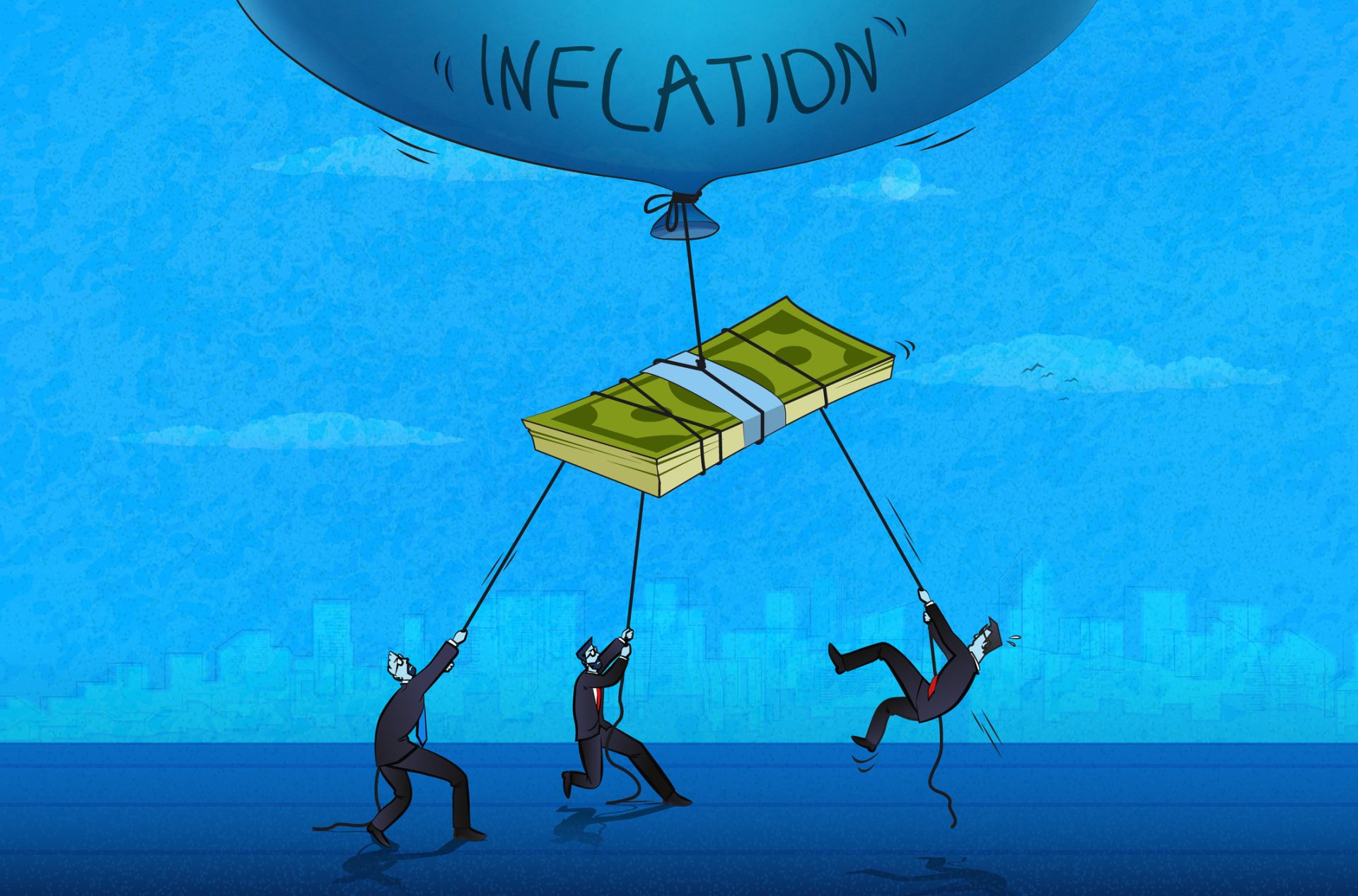

Do popular investing stories hold up in the face of data?
Fact or Fiction?
Investing is often seen as a mysterious, high-risk game reserved only for the wealthy or financially savvy. With the rise of social media influencers and viral “get-rich-quick” schemes, it’s easy to get lost in a sea of misinformation and misconceptions about how investing works. The truth is, investing doesn’t have to be intimidating or based on luck – it is a disciplined, well-researched strategy that anyone can learn.
In this post, I will tackle some of the most common investing myths and misconceptions that can derail beginners and even experienced investors. From the idea that you need a lot of money to start, to the belief that you need to “time” the market perfectly, I will clear up these myths and give you the clarity and confidence to make smarter financial decisions. Whether you are just getting started or looking to refine your investment strategy, let’s dive in and set the record straight.
Myth 1: “Market Timing is Everything” and “It’s Not the Right Time to Invest”
One of the biggest myths when it comes to investing is that active trading or market timing is the best way to achieve high returns. But without knowing the future, it is nearly impossible to make the right calls when it comes to stocks. While some active investors can be successful, this type of success is extremely rare and most investors cannot continually pick winners from losers over and over again. This is why most of us…we should not be trying to time the market. Recall our previous blog on market timing for more information on this.
Luckily, healthy returns can be found in other ways. Instead of trying to actively trade in and out of the market, it is best to stay invested long term. This is especially true during down turns, as missing only a few of the recovery days after a drawdown will significantly hamper your portfolio returns. Even when active traders pick the correct stocks to buy or sell, missing the trade by just one day can result in large gaps in potential return.
The chart below shows the annualized returns of the S&P 500 over the last 25 years, when missing the best days (which are often recovery days).
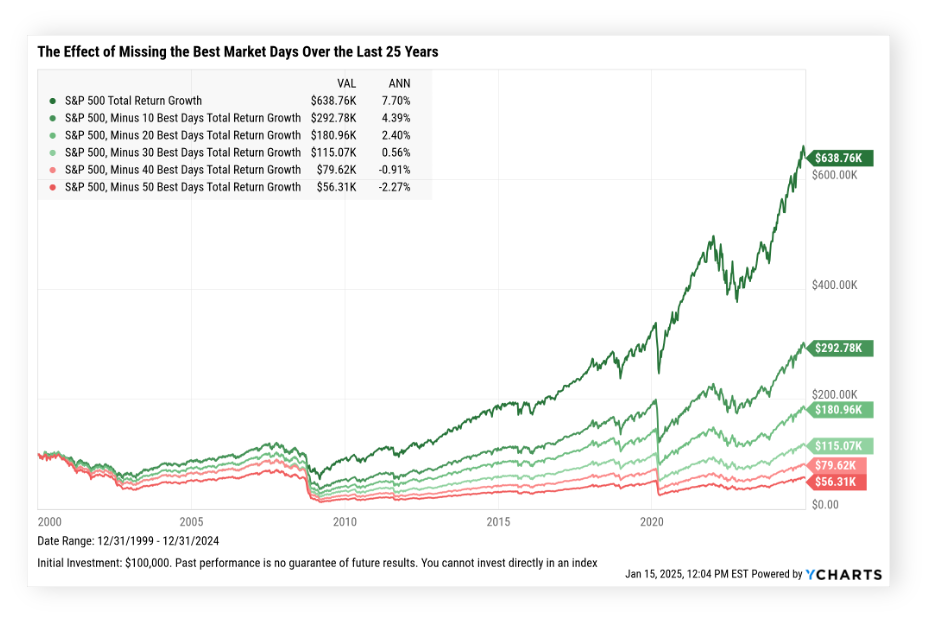
If you stayed fully invested and missed no days, you would have an annualized average return of about 7.70 percent regardless of drawdowns. Missing just the 10 best market days over 25 years cut returns nearly in half, down to about 4.39 percent! If you missed the best 30 days your annualized return is about 0.56 percent.
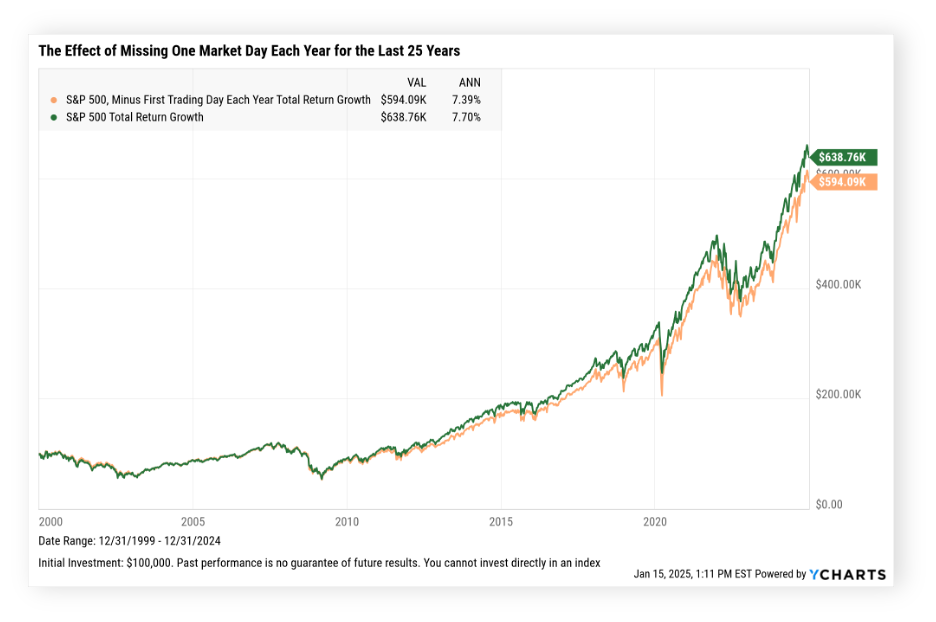
This second chart shows what happens if you missed only one day (not necessarily the best day) a year over 25 years: your portfolio return would have decreased by 0.31 percent. Even brief periods of being out of the market can significantly impact long-term portfolio returns. Staying consistently invested is critical to maximizing growth and avoiding the compounding effects of missed opportunities.
Some of you already invest with a long-term mindset and are not taking your money in and out of the market in a market-timing rat race. But what about when you have additional cash and want to increase your investment overall?
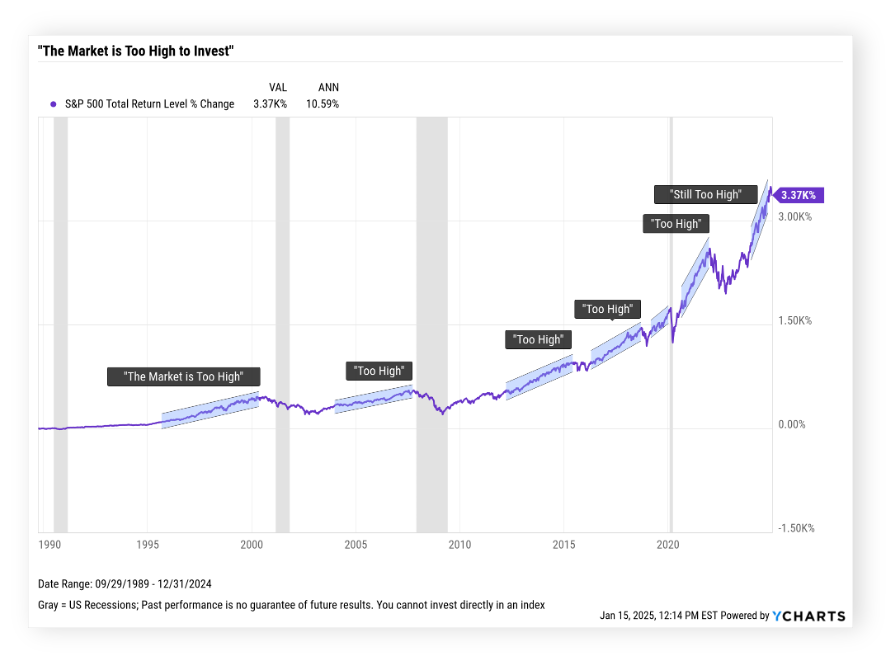
You have probably heard analysts say, “the market is over-priced.” This might lead you to think it is not a good time to invest because the market will have to go down. But waiting to invest when the market is up is just another flavor of the same market-timing impulse that causes people to pull out of markets when they are going down. Once again, timing the market risks missed gains. Data proves getting invested and staying invested beats emotional decisions.
The chart below shows that each time you might think the market is too expensive, it does in fact go higher over time. So waiting for the “right time” can make you miss out on significant gains.
Myth 2: “Cash is King”
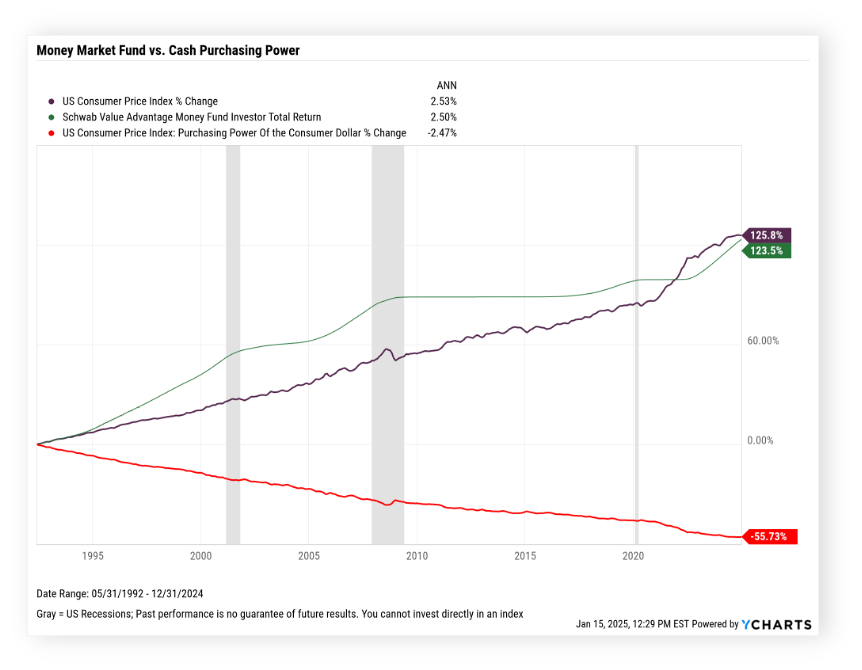
Holding cash feels safe because the face value stays constant, but inflation is actually constantly eroding its purchasing power. The higher inflation is, the quicker your purchasing power is eroded. A money market fund does not generate significant growth, but investing in one as an alternative to cash can help mitigate the effects of inflation.
The chart below shows that, on average, the US Consumer Price Index change (the change in the cost of a basket of common goods) experiences an increase in cost over time, thus reducing your purchasing power. The change is slightly higher than the average annual return for an investor in a money fund, but you can see that dollars invested in a fund are much closer to maintaining their value than the uninvested dollars.
Over time, investing typically outperforms cash savings, especially after inflation. Investing in growth assets like equities, gold, or even fixed income far outpaces cash savings in the long term. Consider the hypothetical growth of an initial $100,000 investment in 1992 through 2024.
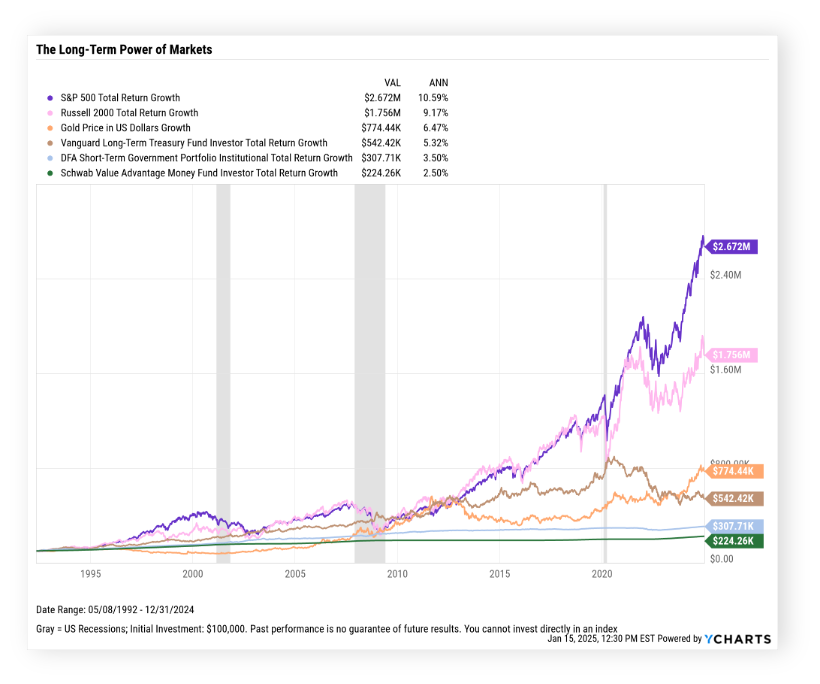
The supposed portfolio invested in the S&P 500 ends with a balance of about $2.7M, one in the the Russell 2000 ends around $1.8M, gold with $774,000, long-term bonds with $542,000, short-term bonds with $308,000, and a money market fund with $224,000. Even without inflation, that is a clear improvement over the initial $100,000. Inflation over the same time period (about 2.5 percent) would have brought the value of $100,000 down to $42,783!
Myth 3: “Stocks are Inherently Too Risky”
While stocks can be risky, it does not mean you should shy away from equities as a whole. Risk works in both directions. Volatility is often misunderstood as excessive risk of loss, but over time, volatility can lead to growth as well. It is often necessary for investors to take on some risk in order to realize higher returns in the future. (More on this later for Myth 6!)
Equities carry higher levels of risk and reward than bonds or cash equivalents. While the standard deviation of the S&P 500 is about 50 percent higher, meaning the results are that much more variable on a monthly basis, than long-term treasuries, the annualized return of the US stock index is almost double that of the long-term fixed income fund.
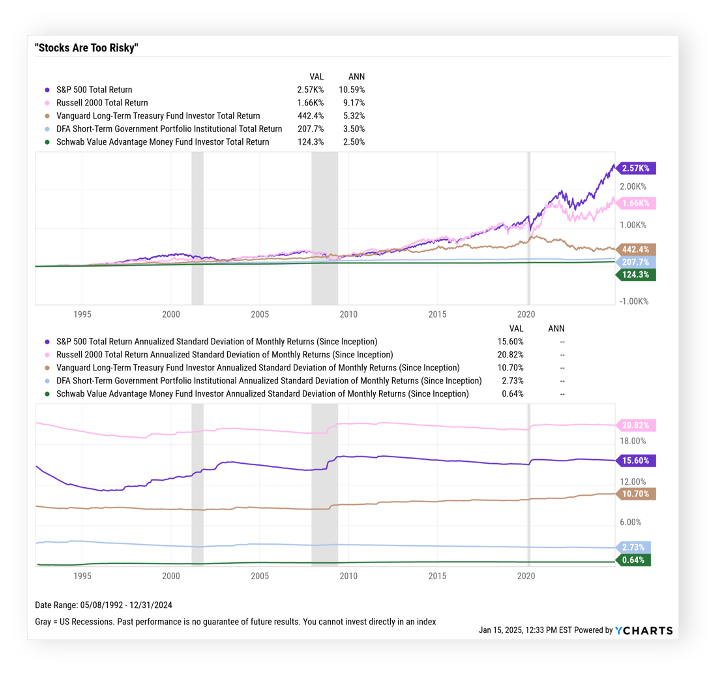
Remember the lesson from Myth #2: if your dollars are not earning money, they are losing purchasing power.
Myth 4: “Stocks Will Always Bounce Back”
There is a big belief that individual stocks will always bounce back. The idea is that if you invest in company A and it experiences a huge drawdown in returns, it must eventually rebound and return more. Right? Well, that is not always the case.
This myth may have come from confusing the performance of the market as a whole (which, historically, does go up over a long enough time frame) with the behavior of single investments. Be wary of the individual stocks you invest in, as sometimes they do not bounce back. Companies go out of business or experience hardships, this is a fact of life. When that happens their stock prices can suffer and sometimes collapse completely.
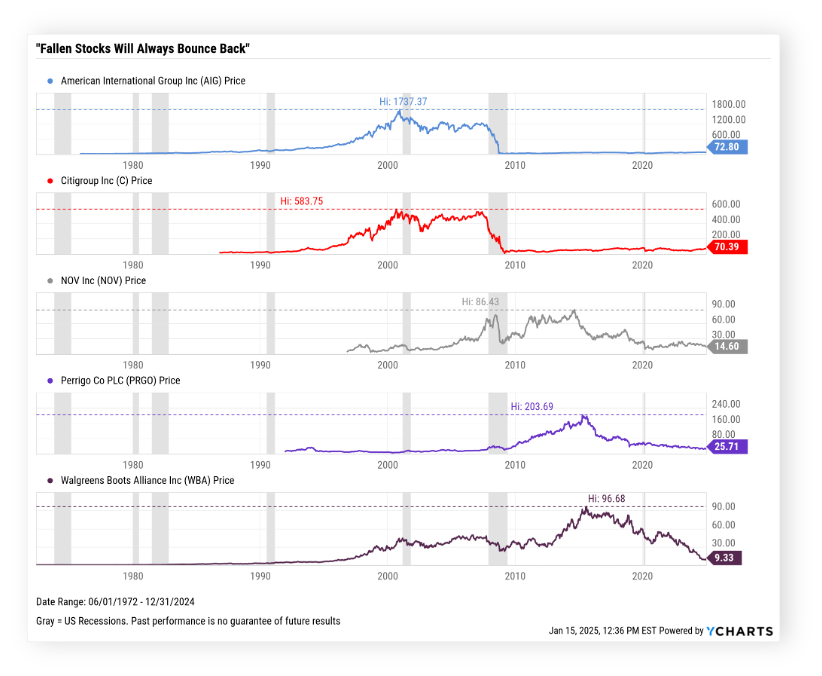
These big-name stocks have reached impressive highs in the past and are now still struggling to bounce back anywhere close to those historical prices. While it is true you do not necessarily want to reflexively dump currently-losing stocks (as you lock in those losses and might miss a rally), with individual stocks that are struggling significantly, sometimes it is best to let go.
Myth 5: “The More Holdings, the More Diversification”
Rather than just increasing the number of different holdings, true diversification reduces concentration risk (too much money in one place) without increasing overlap (too many similar investments). With the rise of ETFs and mutual funds, it is easier than ever to hold hundreds, if not thousands, of different stocks. However, to achieve useful diversification, you still have to be careful not to have too many redundant holdings.
For instance, if we compare sector ETFs to the broad equity market ETFs, there is more concentration risk to the top holdings in the broad equity market ETF. Looking at specific examples, this Sector ETFs Model Portfolio comprises 529 holdings with 16 percent of an investment allocated to the top 10 of those, while a Broad Index Model Portfolio with 3,000 holdings has 27 percent in the top 10. We can take a look at the graphs below charting the performance of each of the hypothetical portfolios.
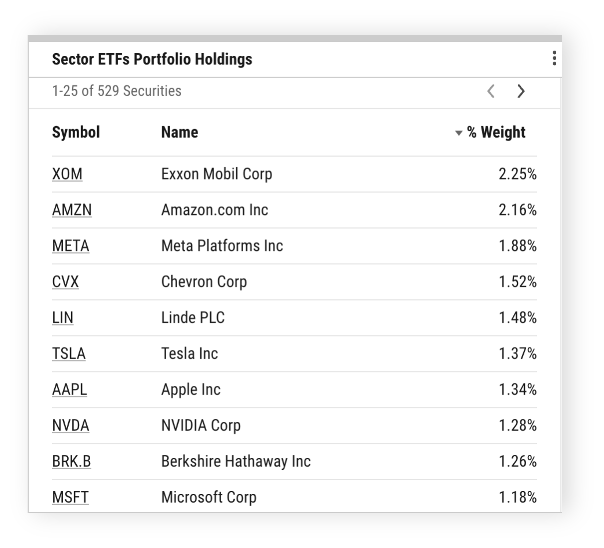
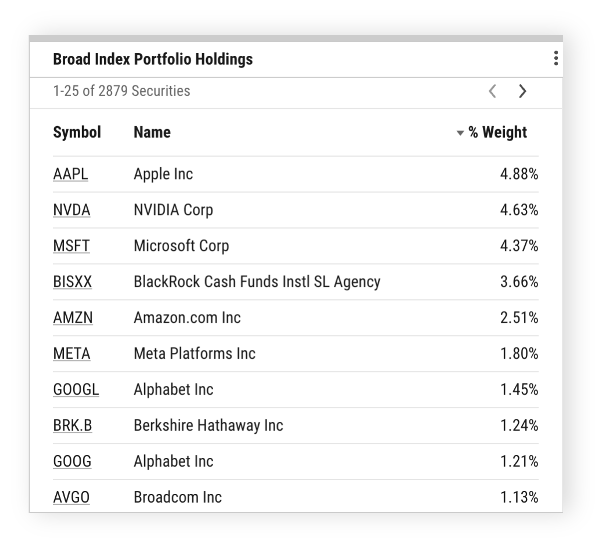
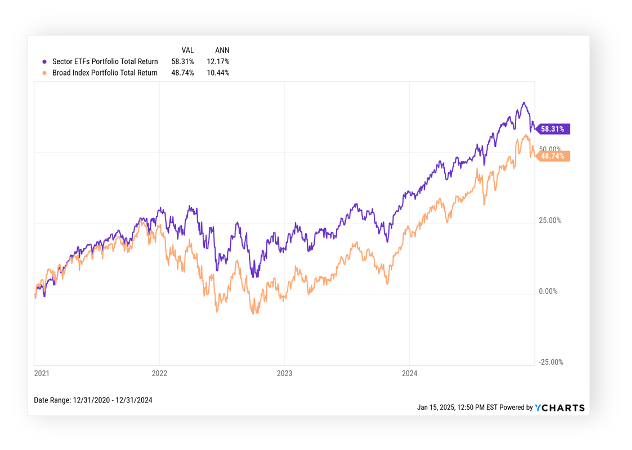
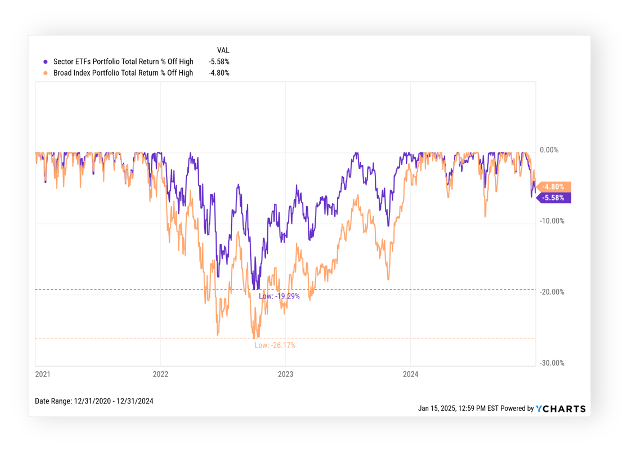
So in this case, investing based on the name or sheer number of investments in the fund would not have worked out as well. You have to review and consider the underlying holdings (and always in the context of your existing portfolio).
Myth 6: “You Need to Take Big Risks”
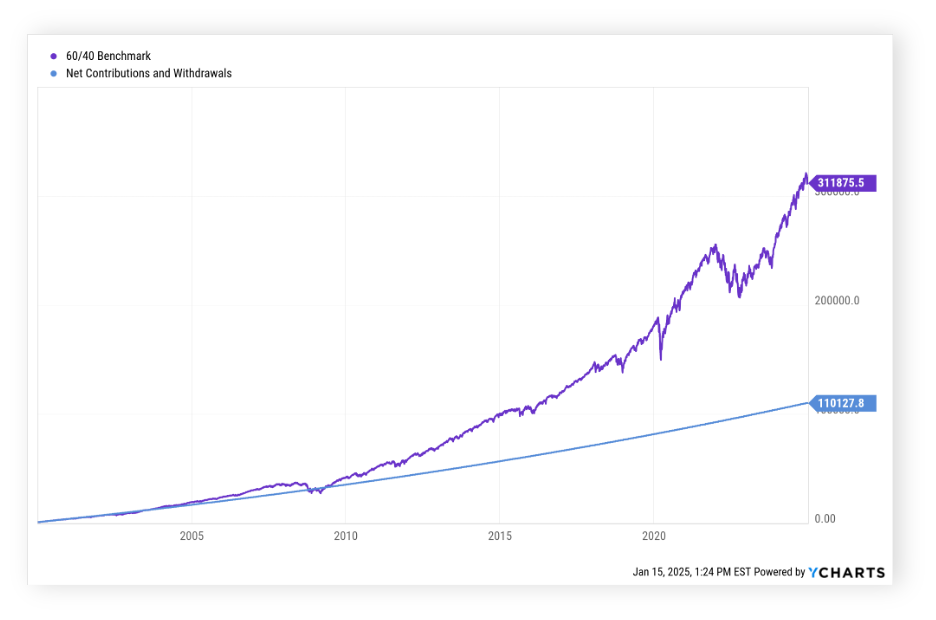
Akin to avoiding “putting all your eggs in one basket”, contributing to investments over time often provides for a smoother – and more rewarding – investing journey. This next chart illustrates an example 25-year investment in a 60/40 portfolio. The initial investment is $1,000 made in January 2000. With ongoing contributions of $250 monthly, with a 3 percent annual increase, from February 2000 through December 2024, the total contribution ends up being $110,128. You can see below that the returns are significant even with such a simple investment strategy.
Investing a lump sum of $110,128 into a single stock on January 1, 2000, would have resulted in the following outcomes:
Boeing (BA)
- High: $1.772M
- December, 2024 value: $728.78K
- Percent off high: -58.9 percent
General Electric (GE)
- High: $218.76M
- December 2024 value: $188.16K
- Percent off high: -14.0 percent
Citigroup (C)
- High: $178.50K
- December 2024 value: $32.30K
- Percent off high: -81.9 percent
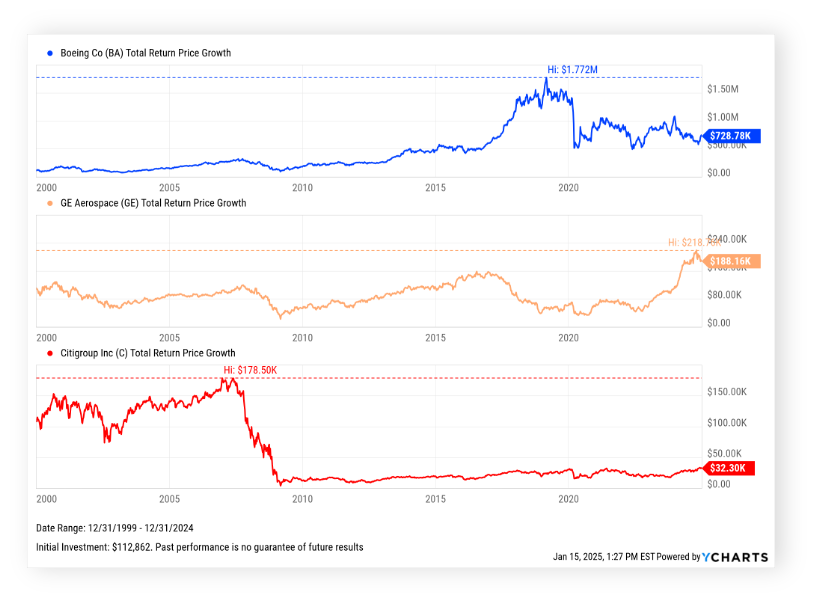
If you had put all your eggs in one basket, Boeing is the only stock that would have resulted in a higher return than a simple 60/40 ETF strategy. While the end portfolio value is attractive, you would have had to stomach an incredible amount of volatility, resisting selling during an almost 60 percent drawdown over several years, compared to what looks like smooth sailing with a 60/40 portfolio. You may have still come out ahead if you sold early, but at what cost to your emotional well-being…and what are the chances that, in a real-life scenario, you pick the one stock that outperforms all others? Could you survive the consequences of being wrong?
By now, you should have a clearer understanding of the most common investing myths and the truths that lie beneath them. The world of investing can seem overwhelming, but breaking down these misconceptions is the first step toward becoming a more confident, informed investor. Remember, successful investing isn’t about following trends or hoping for a quick win – it’s about consistency, patience, and making well-researched decisions over time.
As you continue on your investment journey, keep in mind that knowledge is your most powerful tool. The more you learn, the better equipped you’ll be to navigate the ups and downs of the market with a level head. So, don’t let myths hold you back – take control of your financial future with the facts, and start building the wealth you deserve.
Anessa Custovic, PhD