
When and how does inflation turn into stagflation?
What is Stagflation?
Stagflation is the monster under an economist’s bed. This combination of higher inflation, rising unemployment, and lower economic growth makes it difficult to prescribe any clear cut monetary or fiscal policies because solutions to one piece of the problem are at odds with the other components.
For example, higher economic growth can lower unemployment, but it can also cause higher inflation. Monetary policy that can potentially lower inflation usually slows economic growth as well and can result in higher unemployment. This is what makes stagflation so scary to economists – there is no clear recommended solution, and it can take years to end.
To the average person living through stagflation this could mean rent hikes, frozen wages, or layoffs. Compared to recessions, which are rather common, stagflation is fairly rare in the United States, especially recently. Some differences between the two are the amount of inflation and duration, where recessions tend to be short lived with much lower, less entrenched inflation than in a stagflation environment. Causes of stagflation include government policies and supply side shocks. Some say that today’s government policy (mainly tariffs and fiscal policy mismanagement) and economic environment mirror stagflation episodes of the past. Let’s take a closer look.
Some Historical Context
The figure below highlights the six major episodes of post-World War II inflation. Perhaps the most famous example is episode 4, the 1970s oil shocks, a period where both supply shocks and inflation were rampant. During this time both fiscal and monetary policy responses were gradual. This, combined with multiple oil shocks, set the stage for stagflation.
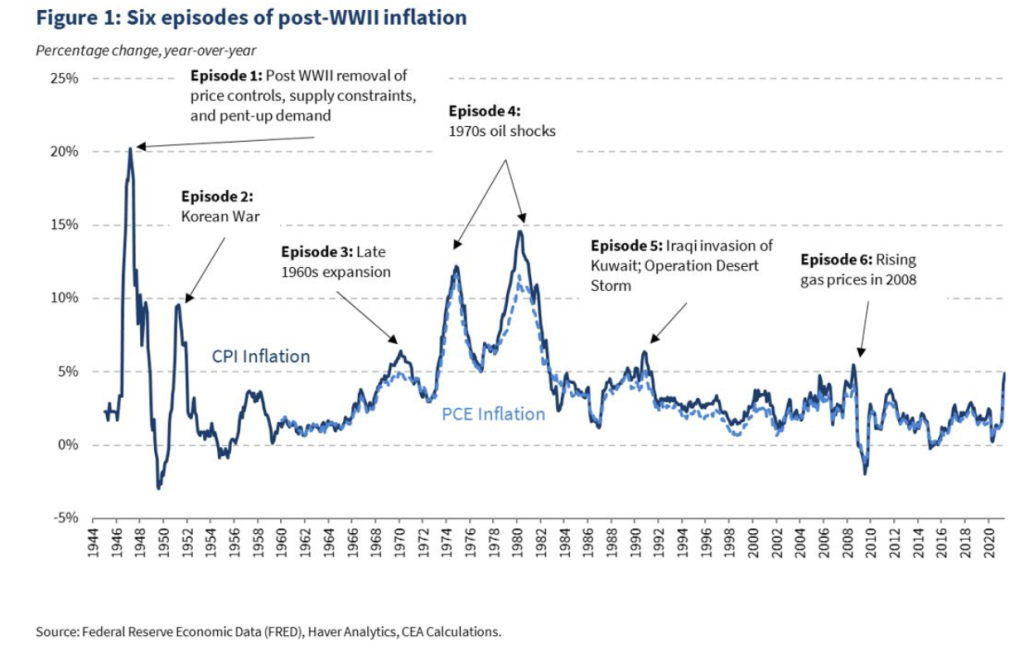
In the post-COVID landscape in 2021 we saw high inflation, yet the Biden administration and Federal Reserve chairman Jerome Powell maintained that inflation would be transitory and not devolve into stagflation. The post-COVID inflation was stubborn and high, perhaps much higher than anticipated, but they were right – it was transitory. Despite fears that it would turn into another 1970s-like stagflation episode, this period did in fact resemble the high inflation in the years immediately after World War II. During both episodes of high inflation there were supply shocks coinciding with high demand (thus causing the bouts of inflation).
Why Inflation Becomes Stagflation
All this begs the question of why sometimes inflation becomes entrenched, like the 1970s episode, instead of being transitory, like the post-World War II and post-COVID eras.
Economic theory explains that entrenched inflation is due to “sticky” prices, meaning the prices of goods tend to be stuck and consistent instead of constantly fluctuating. Sticky prices are good in the sense that you should be able to wake up tomorrow and purchase a good for roughly the same price you did yesterday. But sticky prices can be bad when inflation is higher than usual.
Since producers set their prices relatively infrequently compared to how quickly demand can move, they often increase prices even more than current inflation as a prediction of continued future increases in costs. If more and more producers or businesses do this in the economy, this leads to entrenched inflation. This theory explains some of the fears behind the recent tariffs. If businesses do not believe tariffs are temporary, then they have to increase prices to offset their increased costs. With the current administration’s unpredictability, you can see how this could turn into a scenario where businesses increase prices by even more than current needs require, to compensate for future expected inflation as well.
In theory, in order to stop runaway inflation there needs to be restrictive monetary policy, usually meaning an increase in interest rates. This would hurt the economy by reducing demand and increasing unemployment, turning inflation into stagflation. Without these measures, why then has every recent historical inflationary episode not turned into stagflation? The argument some economists have put forth is that the Federal Reserve System acts as a conceptual backstop.
For stagflation to manifest, producers and retailers need to believe that everyone else will continue to raise prices because they expect everyone else will and so forth: a self-fulfilling prophecy. Long-term inflation is driven mainly by inflation expectations, which are influenced by the amount of faith in the Federal Reserve and its ability to restore order to our monetary system during bouts of inflation.
Are Future Fears of Stagflation Justified?
Stagflation is always a fear because it can last a long time and cause massive strife across the economy, but should we be worried about future episodes given where we are now? With the Federal Reserve’s independence being threatened by the Trump administration, I argue the odds for stagflation greatly increase going forward.
If we erode trust in the ability of the Federal Reserve to act freely as it sees fit, we are eroding the checks on inflation expectations and thus opening us up to actual bouts of stagflation. After all, if there is no trust that the Federal Reserve knows what it is doing, why should market participants believe inflation will be controlled?
Stagflation and inflation may be unsettling, but they don’t have to be paralyzing. By understanding how these forces distort prices, growth, and investor psychology, you can position your portfolio to be more resilient when economic conditions become unpredictable. Diversifying into numerous assets, focusing on quality investments, and keeping a disciplined, long-term perspective can all help buffer the impact of rising prices and slowing growth. Ultimately, preparation – not prediction – is the investor’s greatest advantage.
Anessa Custovic, PhD